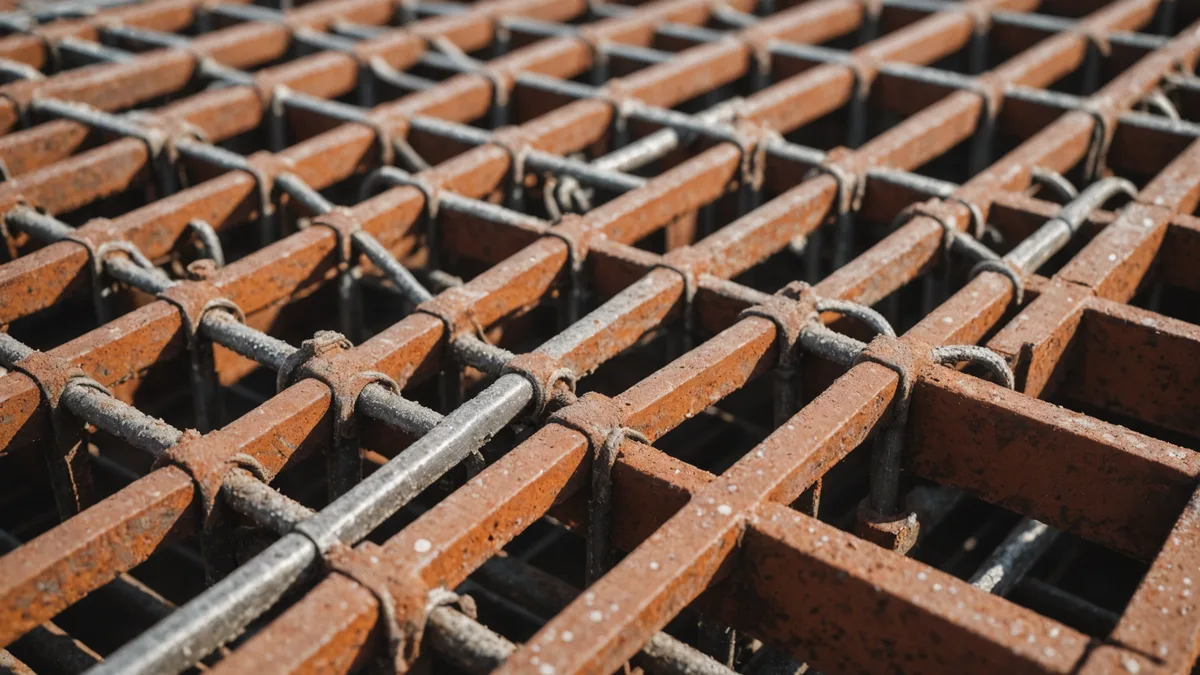
The reinforced concrete poured on a commercial project today will be load-bearing for the next 50 to 100 years. The inspection window before that pour is measured in hours. Getting quality assurance right in that window is one of the genuine high-stakes problems in construction — and also one of the areas where computer vision tools have the most to offer, and the most important limitations to understand clearly.
This article covers what visual inspection models can actually detect at each stage of reinforced concrete work, where they have meaningful blind spots, and what the role of the inspector remains even when automated imagery is running.
Pre-pour: what the camera can see
The pre-pour inspection — the walk-through that happens after forming and rebar placement, before concrete placement — is where most of the preventable quality failures occur. A trained inspector is checking for rebar size and spacing against the structural drawings, cover dimensions (the distance from the rebar to the nearest form face, which determines the concrete cover that protects the steel from corrosion), lap lengths at splices, tie wire presence at intersections, and the presence and spacing of chairs or supports holding the rebar off the form bottom.
Computer vision models working from drone imagery or fixed cameras can flag several of these issues reliably:
- Rebar spacing anomalies. If the structural drawings call for #5 bars at 12" on-center and the grid shows bars at 18" in a section, that's visually detectable. The model looks for consistent spacing patterns and flags zones where the pattern breaks. This works well on flat slabs and wall panels with clear overhead or lateral camera angle.
- Missing chair supports. Chairs and spacers are small but visually distinct. A model trained on the specific chair types in use on a project can flag areas where chairs appear absent or widely spaced. This is one of the more reliable detections because the signal (presence or absence of a small distinct object) is clear.
- Cover depth approximation. From a calibrated camera at a known distance, cover depth can be estimated photogrammetrically when the camera angle allows visibility of the bar-to-form gap at the edge of the slab or at form openings. This is an approximation, not a measurement — it's useful as a screening tool to flag areas where cover looks thin, directing the inspector's attention, not replacing the cover meter check.
- Lap splice presence. Detecting whether a lap splice exists is visually tractable. Detecting whether the lap length meets the structural specification requires knowing the bar diameter and the IBC/ACI requirement for the specific structural condition — the model can flag laps that appear short but needs the spec input to confirm non-compliance.
What the model cannot detect pre-pour
Being direct about the limitations matters as much as describing the capabilities. Several critical pre-pour quality items are not visually detectable from imagery alone:
- Bar grade and size. A #6 bar and a #5 bar look nearly identical in overhead imagery at typical drone altitude. Rebar grade (grade 40 vs grade 60) is completely invisible. The model cannot verify that the installed steel matches the specification. Bar identification requires physical tagging or mill certificate tracking — not imagery.
- Form integrity and geometry. Whether the forms are plumb, braced correctly, and set to the correct elevation requires a combination of survey data and physical inspection. A camera can see obvious form deformation but not subtle geometry errors that affect finished dimensions.
- Embedded items and conduit. Structural drawings often include embedded plates, anchor bolts, conduit runs, and blockout forms. Whether these are correctly positioned and properly secured is only partially verifiable from above — embedded items below the rebar layer are occluded entirely.
- Concrete admixture and mix design. Nothing about the concrete mix — water-cement ratio, admixture type, aggregate size, slump — is observable from imagery. That's a materials testing and batch plant QC domain.
Post-pour and stripping: honeycombing and surface defects
After forms are stripped, the exposed concrete surface can be evaluated visually. This is actually an area where computer vision adds consistent value, because the defects in question — honeycombing, surface voids, bug holes, cold joints, and delamination blisters — are visually distinctive and occur in patterns that a trained model can classify.
Honeycombing — the coarse, open-textured surface that results from incomplete consolidation or bleeding of aggregate — shows up clearly in imagery as a texture anomaly relative to well-consolidated concrete surface. A model trained on severity gradations (minor bug holes acceptable per ACI 301 vs significant structural voids requiring repair) can flag areas for inspector review and estimate approximate affected area.
The practical workflow: high-resolution images of stripped wall panels or columns, taken within hours of stripping, are processed to identify anomalies. The inspector reviews flagged zones with a map rather than conducting a full visual survey of every square foot of surface. On a concrete shear wall package for a 10-floor building — roughly 15,000 to 20,000 square feet of formed wall surface — this reduces the time-to-inspection and ensures no zones are missed because the inspector ran out of daylight.
Cold joints and lift lines are sometimes visible on stripped surfaces as linear discontinuities in color or texture. Detection reliability depends on lighting conditions and how the forms came off — some cold joints appear only under raking light. Imagery collected in overcast flat-light conditions at high resolution produces the most consistent results.
Membrane and waterproofing lap inspection
Applied waterproofing membranes — sheet-applied or fluid-applied, particularly on below-grade walls, podium decks, and plaza decks — have lap and termination requirements that are easy to miss in field inspection because the work happens fast and the coverage area is large. Sheet membrane laps typically need 3" to 6" of overlap depending on the manufacturer and specification; fluid-applied systems need minimum dry film thickness that can't be verified visually but whose coverage pattern can be assessed.
Computer vision inspection of membrane work is most useful for detecting missing or incomplete laps at sheet seams, uncovered penetrations (around pipes, curbs, and drains), and incomplete termination flashing at walls. These are binary detections — the lap either exists or it doesn't — and the failure modes are visually distinct. This is a lower-complexity detection task than rebar geometry, and reliability is correspondingly higher when image quality is adequate.
The inspector's role after adding imagery
Adding automated visual inspection to a concrete quality program changes what the inspector is doing, not whether an inspector is needed. The model's output is a priority-sorted list of anomalies: "rebar spacing irregular in grid zones C4 through C7, cover appears thin near form edge at northeast corner of Bay 14, honeycombing flagged on three panels at Level 6 north shear wall."
The inspector's job becomes: verify the flagged items, exercise judgment on items near the acceptance threshold, and catch the things the camera missed. An experienced structural inspector looking at an area the model has already triaged is doing higher-value work than one conducting an unsupported full-area survey. The inspection doesn't get shorter — the inspector's attention gets better allocated.
This also has documentation implications. An NCR (Non-Conformance Report) supported by imagery of the defect, timestamped and georeferenced to the BIM model location, is a meaningfully stronger document than an NCR supported by written description. When the GC disputes the repair scope, having the original defect imagery tied to a specific IFC element is useful.
One boundary worth stating plainly
Visual inspection models do not replace the Special Inspection program required by IBC Section 1705 for reinforced concrete construction. The special inspector of record has a professional liability obligation that cannot be delegated to a software system. The inspections required by the project's structural engineer of record — pre-pour inspections, high-strength anchor setting, post-installed anchor installation — require a human inspector's sign-off regardless of what imagery shows.
What imagery-based quality inspection does is make that human inspector's time more effective and their documentation more complete. It covers the large-area screening work that's genuinely tedious and error-prone when done entirely by eye, and it creates a persistent visual record that supports the special inspection report rather than substituting for it.
The concrete poured on the projects we're building right now is load-bearing infrastructure that will outlast everyone in the OAC meeting. Treating visual inspection tools as a replacement for rigorous QA misunderstands both what the tools do and what the stakes are. Used well, they make the rigor more consistent — which is the actual goal.