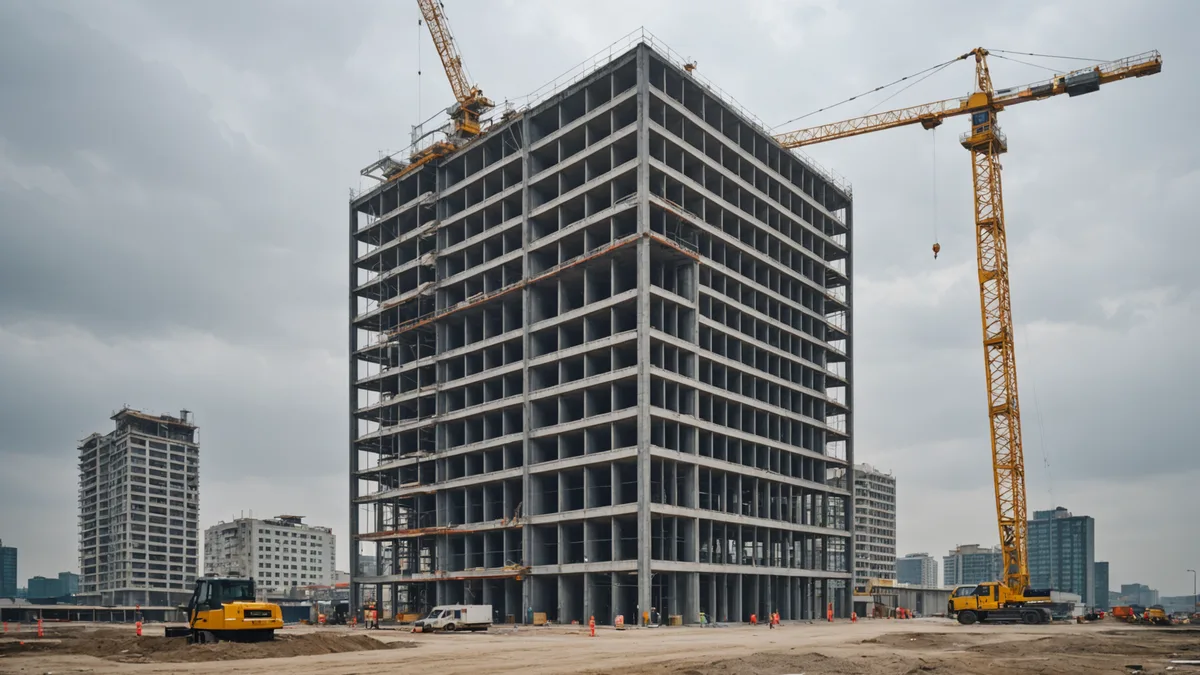
A project health score of 74% sounds useful until you realize that number is covering for Floors 12 through 18, where structural steel is two weeks behind, and Floors 3 through 7, where MEP rough-in is actually running ahead. The aggregate masks both the problem and the opportunity. On a 30-floor commercial high-rise, progress isn't one number — it's 30 numbers, multiplied by the trade count you're tracking.
This is a problem that's gotten more painful as buildings get taller and schedules get faster. CPM schedules for high-rise commercial work typically show activity durations of 3 to 5 days per floor per trade, with float measured in hours rather than days in the critical windows. A one-floor slip at the steel level can cascade into a 10-day delay by the time MEP and drywall sequencing gets disrupted. But you only find it fast if your progress data is granular enough to flag it at the floor level before it ripples.
Why Aggregate Progress Data Fails on Tall Buildings
The instinct to roll up progress to a single project percentage is understandable — owners want one number, the schedule software wants one number, the monthly owner's report wants one number. The problem is that on a vertical building, the floors in play span radically different construction phases simultaneously. On a given Tuesday, you might have concrete deck pours happening on Floor 22, steel erection on Floor 25, MEP rough-in on Floor 14, drywall on Floor 8, and finish work on Floor 3. Each of those activities has different labor requirements, different subcontractor crews, different critical path relationships.
When you roll those up into a single health score, you lose directionality. A 3% behind-schedule flag at the project level might mean you're uniformly 3% slow everywhere, which is manageable. Or it might mean Floors 15 through 20 are 15% behind and Floors 1 through 8 are 8% ahead because the finish trades are moving faster than planned. Those are completely different recovery strategies, and you can't tell them apart from the aggregate.
The floor-level view also matters for trade sequencing decisions. In high-rise concrete construction, the follow-on trades — MEP, fireproofing, interior framing — typically begin their work three to five floors below the active concrete deck. If concrete erection slips two floors on the upper half of the building, that slip propagates downward through the trade sequencing like a slow-moving wave. By the time drywall crews on Floor 12 have run out of ready-to-hang area, the delay has grown considerably. Catching the concrete slip at Floor 22 when it first shows up, not when it arrives at Floor 12, is the difference between a correctable schedule event and a claim conversation.
What Floor-Level Tracking Actually Requires
Tracking progress at the floor level sounds obvious, but doing it reliably is harder than it sounds. The typical site visit-based approach — superintendent walks the floor, estimates percentage complete, enters a number — has several failure modes on a tall building. Visual estimates from a floor plate are notoriously imprecise for activities like MEP rough-in, where a crew might have 60% of the conduit in and 0% of the piping started, and an untrained eye sees a floor that looks "about half done." Estimating completion on an activity you're not personally familiar with is where the 10-15 percentage point reporting error comes from.
The other failure mode is coverage. On a 30-floor building with 200-plus workers, a single superintendent walk produces spot observations, not systematic coverage. The floors that are behind tend to be the ones the superintendent doesn't have time to walk that day, because the hot issues are pulling attention to the floors with active problems. Progress data gathered under that constraint is structurally biased toward underreporting problems.
Aerial capture changes the coverage math. A drone flight that traverses every accessible floor in a 45-minute mission produces consistent imagery of every floor, regardless of which floors are having a good day. The superintendent's attention constraint doesn't determine which floors get measured. That consistency matters most precisely when one floor is in trouble and another is fine — which is exactly the condition an aggregate score obscures.
How Per-Floor BIM Comparison Works in Practice
The floor-level tracking approach we've built at Bimvyne starts with the 4D BIM model — the model with schedule activities tied to specific BIM elements. Each structural column, each beam, each MEP segment, each wall assembly is associated with an activity and a planned completion date. When a drone scan comes in, the photogrammetric output gets compared against the BIM model, element by element, floor by floor.
The output isn't a single percentage. It's a per-floor, per-trade completion matrix. Floor 14, MEP rough-in: 61% complete against a planned 75% at this date. Floor 14, structural framing: 100% complete, two days ahead. Floor 18, MEP rough-in: 28% complete against a planned 55% — that's the one that needs attention in this week's trade coordination meeting.
This structure maps directly onto how PMs actually work. The 3-week look-ahead isn't organized by project percentage — it's organized by floor and activity. A floor-level deviation report slots directly into the OAC meeting agenda and the subcontractor coordination conversation. You walk into the MEP sub's trailer with a specific floor number and a specific percentage gap. That's a different conversation than "MEP is running behind."
The Compounding Effect on Schedule Float
One argument worth making explicitly: the value of floor-level tracking isn't just diagnostic, it's predictive. In a CPM schedule, a floor-level activity that's running behind affects all the successor activities tied to that floor. If you can identify a floor-level deviation two weeks before the successor activities are scheduled to start, the recovery window is still open. If you identify it when the successor activities are already mobilized and waiting, the recovery window has closed and you're into acceleration cost or claim territory.
The math on construction delay costs is unfavorable. Daily extended general conditions on a commercial high-rise — superintendent labor, equipment rental, crane costs, temporary utilities — typically run in the range of $15,000 to $40,000 per day depending on project size. A schedule detection improvement of two weeks converts into a meaningful cost avoidance number. Floor-level tracking is one of the few places where the granularity of your progress data has a direct, calculable relationship to your risk exposure.
We're not saying floor-level tracking eliminates schedule risk — it doesn't. Subsurface conditions, weather, material delivery delays, labor availability in the local trade market all create schedule variability that no amount of progress monitoring eliminates. What floor-level tracking does is narrow the window between a problem occurring and your awareness of it. That's a meaningful operational improvement, not a complete solution.
What to Do With Floor-Level Data in Your Meetings
The most common question when teams first start getting floor-level deviation data is: how do we use this in the weekly OAC? The answer is simpler than you might expect. The floor-level matrix becomes the factual basis for the schedule update discussion rather than a debate about whether the sub's self-reported numbers are accurate.
Standard practice: run the drone capture two to three days before the OAC meeting. Process the floor-level comparison. Bring the per-floor status into the meeting organized by trade. Any floor showing more than 8-10% behind plan for that trade gets flagged for discussion. The sub either provides a recovery plan or you adjust the 3-week look-ahead to reflect the actual current state. Either outcome is better than presenting a schedule update where everyone in the room suspects the numbers are optimistic.
The other use case is the AIA G702/G703 payment application review. Stored material and in-place work percentages in pay apps are notoriously subject to over-reporting, particularly during tight cash flow periods on the sub's side. Floor-level completion data gives the PM a cross-reference against which to validate payment applications. Not a tool to dispute legitimate work, but a tool to catch significant discrepancies between reported completion and observed installation. It rarely catches outright fraud, but it regularly catches the kind of optimistic percentage reporting that costs the owner through unearned front-loading of payment draw schedules.
The Floor Resolution Question
A practical note on what "floor-level" actually means: the granularity that's useful depends on your building's floor plate and activity structure. On a 15,000 square foot floor plate with a single major activity per trade, floor-level is probably the right resolution. On a 45,000 square foot podium floor with multiple zones, activity, and different trade fronts in different zones, you may want zone-level or even bay-level tracking for certain high-value activities like post-tensioned slab or MEP main runs.
The practical constraint is that BIM element granularity and drone capture resolution have to match. If your BIM model has structural elements defined per column and beam but MEP elements only defined per riser run, your tracking resolution will be correspondingly asymmetric. Getting full value from floor-level progress tracking means having a BIM model that's been built with element-level granularity tied to activity-level scheduling — which is increasingly standard for commercial high-rise work but still varies considerably between project teams and BIM execution plans.
If your 4D BIM model is structured at that level of detail, floor-by-floor tracking becomes a natural extension of the coordination process already in place, not an additional workflow layer. If it isn't, the conversation about upgrading the BIM execution plan is worth having before the next high-rise project's design phase closes.