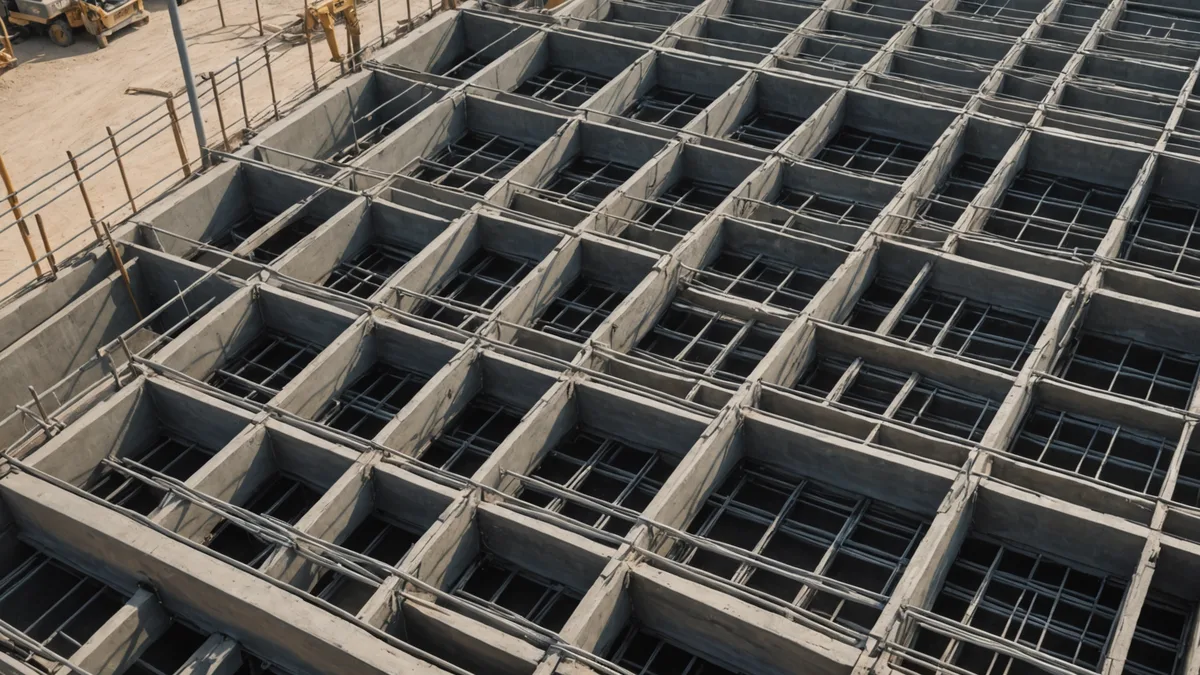
Reinforced concrete quality defects have a particularly inconvenient characteristic: many of them are only visible during the window between rebar placement and concrete pour — a window that typically lasts between 24 and 72 hours on an actively sequenced floor. Once the pour happens, the defect is either discovered through destructive investigation (core drilling, GPR scanning, chipping), which is expensive, or it becomes a latent issue that surfaces later as a structural concern, a durability problem, or a liability claim.
The traditional inspection approach — a concrete inspector or the GC's QC superintendent walks the mat before the pour, checks key parameters, approves or denies — works reasonably well when inspector coverage is complete and consistent. It works poorly when the inspector has to cover three active floors, when pours get sequenced under time pressure, or when the parameters being checked are numerous enough that visual inspection genuinely misses things.
Aerial imagery captured systematically during the pre-pour window adds a layer of coverage that the human inspector can't reliably replicate. Here are the four defect categories where that coverage matters most.
Defect 1: Rebar Cover Depth Violations
Concrete cover — the distance between the exterior concrete surface and the nearest rebar — is one of the primary parameters governing reinforced concrete durability and corrosion resistance. ACI 318 specifies minimum cover depths by exposure condition: 3/4 inch for interior slabs not exposed to weather, 1.5 inches for slabs exposed to weather, 2 inches for cast-in-place members in contact with ground. In structural applications, cover less than specified can accelerate carbonation-induced corrosion, particularly in exterior members, parking structures, or below-grade concrete.
The mechanism for violations is straightforward: rebar chairs or spacers that are inadequate for the specified cover, omitted, or displaced during placement. A mat that looks correctly spaced from a standing inspection may have inconsistent chair placement at 10-20% of the support points, producing localized cover violations that are invisible from any single vantage point but detectable in overhead imagery with sufficient resolution.
Aerial imagery captures the entire mat from above, making chair placement visible across the full floor plate. Systematic analysis can flag areas where chair spacing is irregular or where chairs appear absent. This isn't a replacement for a close physical inspection of chair height and adequacy — imagery doesn't give you a tape measure reading of cover depth — but it provides a consistent, documented check of placement that identifies suspect areas for physical follow-up before the pour window closes.
Defect 2: Form Tie Spacing and Condition
Formwork tie spacing directly governs form deflection under pour pressure. Ties that are spaced beyond the engineered specification, or that are present but haven't been properly tightened or anchored, create a risk of blowout under hydrostatic pressure during the pour — one of the more dramatic quality failures in cast-in-place construction, and one that produces both safety risk and expensive concrete waste and re-forming cost.
Tie spacing violations typically show up in overhead imagery as irregular spacing patterns in wall or column formwork. A designed tie spacing of 12 inches on a wall form that shows actual spacing in the 14-18 inch range across several bays is a flag worth investigating before the pour sequence begins. Ties that are present but not engaged — visible as un-tightened hardware — are also detectable in high-resolution imagery.
The human inspection failure mode here is that tie spacing in a dense reinforcing environment is tedious to check systematically on a walk. An inspector checking 200 linear feet of wall formwork with complex rebar congestion around openings can miss systematic spacing errors while correctly identifying individual non-compliant ties. Overhead imagery has no blind spots from congestion and captures the full perimeter in a single pass.
Defect 3: Honeycombing Risk Indicators — Rebar Congestion and Vibrator Access
Honeycombing — voids in hardened concrete resulting from incomplete consolidation — is one of the most common quality defects in reinforced concrete and one of the most difficult to detect after the fact without destructive investigation. The primary causes are inadequate vibration during placement, rebar congestion that prevents vibrators from reaching all areas, pour rate that exceeds consolidation capacity, and aggregate size that doesn't flow freely through congested reinforcement.
The risk indicators are visible before the pour. Overhead imagery of a reinforced mat or congested beam cage can flag areas where rebar spacing is tight enough to restrict vibrator access — specifically, areas where the clear spacing between bars is less than 1.5 times the maximum aggregate size, or where rebar splices, lap lengths, and stirrup congestion create localized areas of high density. These are the areas where a careful pour sequence and multiple vibrator passes matter most, and they're the areas that are most likely to receive inadequate consolidation when workers are moving quickly on a large pour.
Flagging these areas before the pour lets the superintendent and concrete sub discuss pour sequence, vibrator placement strategy, and whether mix design adjustments (higher slump, admixtures, different aggregate gradation) are warranted. It turns a post-defect investigation into a pre-pour planning conversation — a much better use of the observation.
Defect 4: Waterproofing Membrane Gaps and Damage
Below-grade and plaza deck waterproofing is a category that gets inadequate inspection attention relative to its consequence. A failed waterproofing membrane on a below-grade slab or a below-grade wall typically produces water intrusion that becomes apparent 6-18 months after occupancy, at which point the remediation involves disrupting finished spaces, chasing leaks through multiple pathways, and potentially performing repairs from the exterior — which means re-excavating alongside a completed structure.
The defect types that aerial imagery catches in waterproofing are: laps that haven't been fully heat-welded or adhered, termination edges that are lifting, membrane tears or punctures from subcontractor foot traffic during backfill or slab preparation work, and areas where membrane has been displaced from its substrate without returning to proper adhesion. These defects are often small in area but catastrophic in consequence — a 4-inch unsealed lap in a sheet membrane covering a 6,000 square foot below-grade slab will produce infiltration at that lap for the life of the building.
Overhead inspection of membrane work is genuinely superior to walking inspection for detecting displaced or unsealed laps, because the top-down view makes lap edges visible across the entire membrane plane rather than requiring the inspector to crouch and examine each lap individually. For a large below-grade slab where hundreds of linear feet of membrane lap are present, aerial capture provides complete coverage in a fraction of the time a walking inspection requires.
The Timing Constraint: Pre-Pour or Pre-Cover Windows
All four of these defect categories share the same critical constraint: they're only correctable before the concrete is placed or before covering work begins. This is where the scheduling of aerial capture matters as much as the capability to detect the defects.
A capture that happens 72 hours before a scheduled pour gives the QC team time to review the imagery, flag suspect areas, schedule physical follow-up, and document corrections before the pour window opens. A capture that happens 4 hours before the pour — or after the pour starts — has limited value even if it detects every defect on the list, because the response window has closed or never existed.
We're not saying aerial inspection replaces the physical pre-pour inspection — it doesn't. ACI standards and most owner's inspection requirements involve physical measurement and documentation that imagery can't substitute for. What aerial capture does is extend the coverage of that inspection to the full floor plate, at consistent resolution, documented with timestamps and coordinates that support both QC records and any future investigation. It's an additive layer, not a replacement.
The practical workflow that works best: fly the pre-pour capture 48-72 hours before the scheduled pour. Review imagery for the four defect categories with a checklist tied to the specific pour's BIM element set. Flag any suspect areas for physical follow-up within the next 24 hours. Document corrections in the QC log with image references. Release for pour when physical inspection confirms. The imagery capture adds maybe 45 minutes to a pour prep sequence that probably runs two to three days anyway — and it produces documented evidence that systematic pre-pour inspection was performed, which matters considerably if a quality issue emerges later.