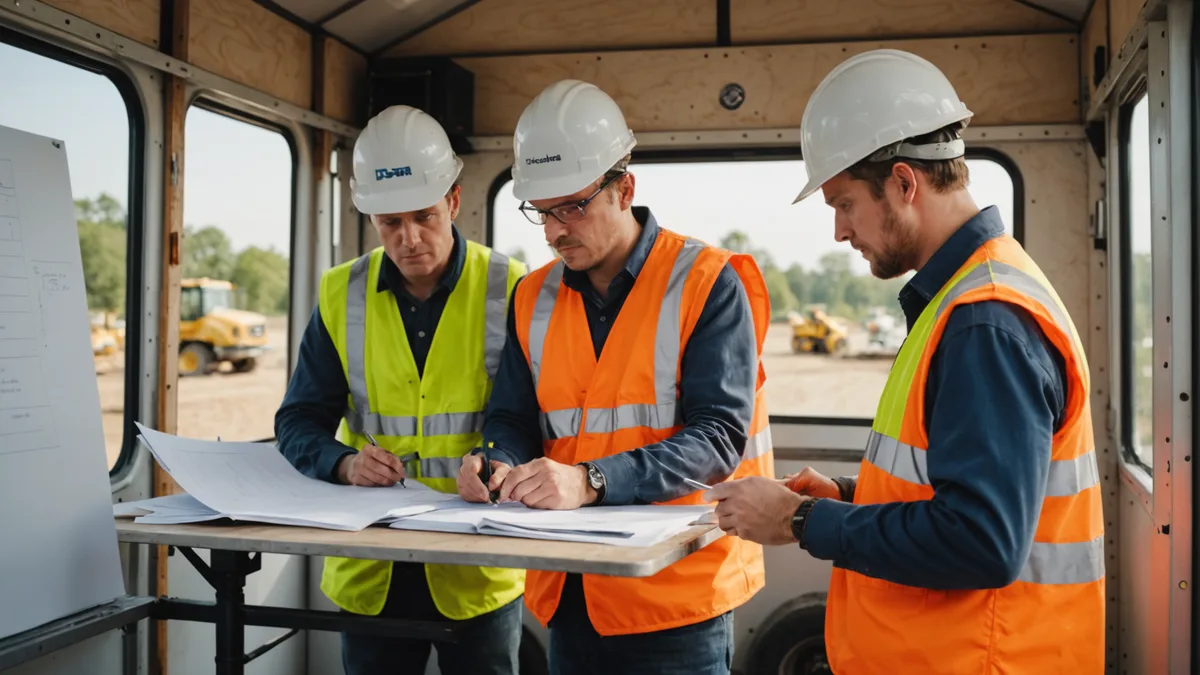
Every construction project manager has had the experience. It's Friday at 3pm. The weekly report landed in your inbox that morning saying the MEP rough-in on Floors 8 through 11 is "on track, approximately 85% complete." Then you do a floor walk and discover that Floor 9 hasn't been touched since Wednesday because the mechanical sub is waiting on a change order that nobody told you was in dispute.
This isn't an unusual story. It's so common that most PMs have built a silent 15-20% discount into everything they hear from subs. The problem is that number is arbitrary — sometimes the report is accurate, sometimes it's off by 30 points, and there's no reliable way to tell which is which without doing the field check yourself.
Understanding why progress reports are structurally unreliable is the first step toward building a monitoring approach that doesn't depend on the accuracy of self-reporting.
The principal-agent gap at the heart of it
The self-report problem in construction is a classic principal-agent problem: the person generating the progress measurement (the subcontractor superintendent) has different incentives than the person consuming it (the GC project manager or owner's rep). The sub's incentives aren't simply to deceive — they're considerably more nuanced than that, and that nuance is what makes the problem hard to eliminate through better reporting forms or stronger contracts.
Subcontractors face a set of pressures that pull their reported numbers away from ground truth in predictable directions:
- Payment application timing. Progress percentage is the input to AIA G702/G703 pay apps. A sub reporting 65% complete on a $2M package is waiting on a different payment than one reporting 80%. When the payment cycle is tight, the reported number has a financial valence that's hard to strip out.
- Change order positioning. If a sub is in a CO dispute, reporting ahead of schedule creates negotiating leverage. Reporting behind schedule on unrelated work can weaken their position in the dispute. Progress numbers get managed to support the larger commercial relationship, not just to inform the schedule.
- Crew retention signaling. A sub who reports being significantly behind might get their crew reassigned or their contract scrutinized. Keeping the number plausible, even when the work is lagging, is a form of self-preservation.
- Optimism bias and round numbers. Humans estimating percent complete without a systematic count tend to anchor on round numbers and bias toward optimism. "About 80%" usually means "somewhere between 70 and 90, I think." It's not a lie — it's a soft estimate that gets treated as a hard data point.
The role of the GC in the problem
It would be easy to frame this as a subcontractor honesty problem. It isn't. General contractors have their own version of the same incentive misalignment when reporting to owners.
The monthly owner report — that document that lands in the owner's rep inbox and gets summarized for the board — is often a masterpiece of optimistic framing. "The project remains substantially on schedule" is technically consistent with being 3 weeks behind on the critical path if the GC believes they can recover. The communication is not false. It's just calibrated to avoid triggering owner anxiety that the GC doesn't think is warranted yet.
By the time the GC is certain that a delay is unrecoverable, they've often already lost the window where early owner involvement could have helped — by approving overtime, adjusting phasing, or accepting a partial scope reduction. The owner finds out at the same time the problem becomes undeniable, not when intervention would have been most useful.
Why better reporting formats don't fix it
The construction industry has tried many versions of "if we just improve the reporting template, we'll get better data." The evolution from typed field reports to Procore daily logs to photo-required status updates represents genuine progress in documentation completeness. But it doesn't change the fundamental problem.
A detailed Procore update with photos can still be optimistically framed. Photos of work in progress look similar whether the work is 60% or 80% done — the camera doesn't tell you what percentage of the IFC elements in that zone have been installed. The photo documentation improves dispute resolution and record-keeping, which is genuinely valuable, but it doesn't give the GC or owner an independent progress measurement.
Some teams have moved to requiring contractors to check off specific items in a pre-populated task list tied to the BIM model. This is meaningfully better — at least the completeness definition is shared. But the data entry is still done by the sub, and the verification is still the PM walking the floor, which is exactly the labor-intensive bottleneck that prevents consistent monitoring.
What an independent measurement changes
The structural fix to the self-report problem isn't more auditing of self-reports — it's generating independent observations that don't pass through the reporting party.
This is why photogrammetric site scanning tied to a BIM model is a different category of tool than any improvement to reporting workflows. A drone flight produces an observation of the physical site. That observation gets compared against the model geometry. The result is a completion percentage derived from geometry present in the point cloud versus geometry expected in the BIM — a number that the subcontractor didn't input.
We've found that when subs know independent scan data is being generated, their self-reported numbers track closer to what the scan shows. Not because they're suddenly honest in a way they weren't before — they were never trying to deceive anyone in most cases — but because the round-number optimism bias gets corrected when there's an objective reference point. "I think we're at 80%" becomes "the scan last week showed 74%, we've done about a floor since then, so call it 78-79%." That's a genuinely useful number.
We're not suggesting this eliminates all reporting friction. Disputes about what "counts" as installed will still happen. A structural steel element that's in place but not fully connected might show up in the scan without showing up as "complete" in the CPM definition. Those conversations still need to happen. But they happen with a shared factual baseline that's not owned by either party — which makes them faster and less contentious.
The Friday afternoon problem, specifically
One thing that doesn't get enough attention is the timing asymmetry between when problems develop and when PMs hear about them. Most critical-path slips don't originate on Friday. They originate Monday through Wednesday when crews run into coordination problems, material delays, or hidden conditions, and the sub superintendent decides to try to resolve them quietly before reporting up. By Friday afternoon, a 3-day problem has become a 5-day problem that the PM is hearing about for the first time.
The standard 7-day weekly reporting cycle means you're always working with data that's at minimum a week stale, and potentially 12-14 days stale if you count the lag from when the problem started to when it showed up in the report. For a project where every day of critical-path delay has a real cost in general conditions, that's a meaningful amount of runway you're burning before you even know you have a problem.
Twice-weekly or three-times-weekly site scanning — even partial scans focused on active work zones — compresses that discovery cycle to 2-3 days. The sub still has their incentives. The reporting still goes through the same human filters. But the imagery data runs on its own clock, independent of who calls whom and when.
A note on the adversarial dynamic
Some PMs are skeptical that imagery-based monitoring will sour relationships with subs who feel they're being surveilled. It's a fair concern, and the framing matters. The most effective approach we've seen is positioning the scans as serving a shared interest: the PM doesn't want to escalate problems that don't exist, and the sub doesn't want to be blamed for problems that are actually upstream coordination failures. Independent imagery protects both parties by creating a factual record.
The sub who had a legitimate delay because the electrical couldn't pull wire until the GC cleared access — that timeline is now documented in the scan history. The accountability flows in all directions, not just downward.
The self-report problem is structural. It exists because the incentive to manage appearances is real and the cost of doing so is low when there's no independent verification. Eliminating the incentive isn't realistic — it's woven into how construction contracts work. But changing the verification mechanism changes the dynamic enough to produce substantially better data, which is the starting point for everything else.